
Life After a Narcissist:
New Program March 5, 2026
A Three-Month Depth Program for Reclaiming Agency, Identity, and Creative Authority
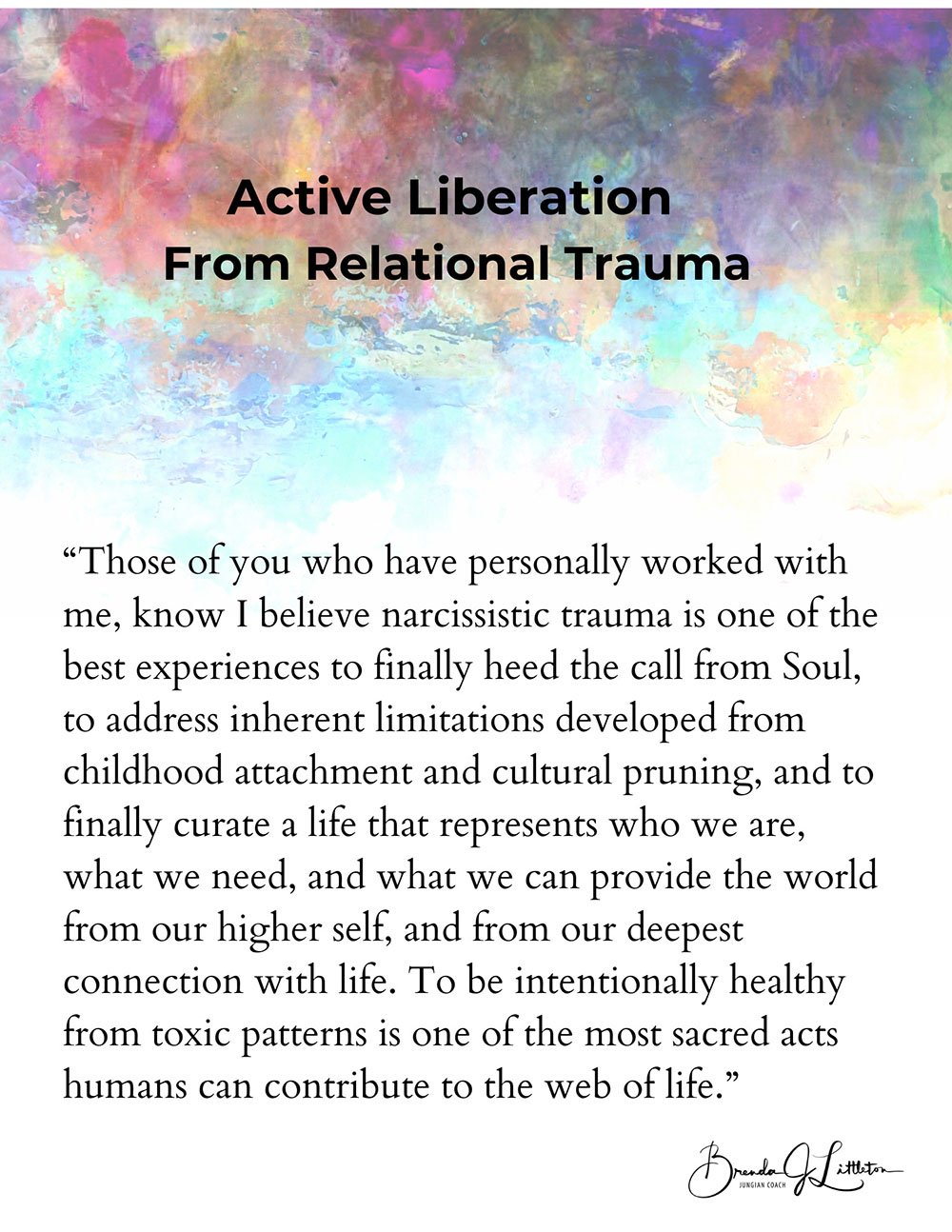
Over time, these conditions shape not only how we relate to others, but how we relate to ourselves.
And because the nervous system seeks familiarity in order to predict safety, those raised within narcissistic dynamics often find themselves repeating similar relational patterns in adulthood, including intimate partnerships, not out of weakness, but in an unconscious attempt to finally resolve what could not be addressed earlier.
Gaslighting.
Walking on eggshells.
Emotional withdrawal.
Intermittent approval.
The slow erosion of your self-trust.
And yet, even after the relationship or environment ends, many high-functioning, intelligent, deeply creative individuals find themselves still living within its architecture. You are no longer being criticized, but you hesitate before you speak. No one is actively diminishing your needs, but you continue to minimize them. You are free to move forward, yet something in you reflexively scans the room for permission.
Life after narcissistic entanglement is rarely defined by a dramatic exit alone. It is defined by what happens next.
Because the truth is that narcissistic environments do not only train you to tolerate distortion from others. They train you to distort your own perceptions in order to survive. Over time, self-silencing becomes self-protection, compliance becomes connection, and self-abandonment becomes mistaken for maturity.
And we do not recover in a vacuum.
We are living in a time in which narcissistic forms of power have moved beyond personal relationships and into the very systems we once trusted to reflect and protect our voice. Institutions, workplaces, families, and cultural narratives increasingly deny lived experience, minimize expression, and subtly reframe fear, doubt, and isolation as reasonable forms of protection. It becomes easier to withdraw than to risk being misunderstood. It feels safer to remain small than to invite scrutiny. In this atmosphere, vigilance can masquerade as wisdom, and emotional numbness can be mistaken for resilience.
Many of my clients arrive at midlife with an emerging, embodied life that wants to be lived at full volume, while simultaneously believing they must compress that life into old patterns of politeness, responsibility, and emotional manageability. They stop themselves before anyone else can. They edit their joy before it inconveniences someone. They pre-emptively gaslight their own knowing in order to maintain belonging.
Which is why healing cannot remain an entirely private act.
We require each other in community to mirror our pain without distortion, to validate our awareness without minimization, and to support the gradual rebuilding of intuitive trust that narcissistic environments, both personal and systemic, have trained us to doubt.
This program begins with a simple but confronting truth:
You may no longer be in the relationship, but the relationship may still be in you.
Over the course of three months, we will explore the psychological and somatic imprints left by narcissistic attachment, including:
• chronic self-doubt and second-guessing
• anxiety linked to visibility, success, or creative expression
• the compulsion to over-explain, justify, or apologize
• difficulty identifying desire without guilt
• a nervous system conditioned for hyper-vigilance or emotional numbing
• internalized criticism that now speaks in your own voice
A primary function of this program is to help you identify the ongoing process of self-gaslighting in real time, and to develop the capacity to pivot out of reflexive self-doubt into intuitive trust and guiltless choice-making. You will learn how to recognize when your nervous system is confusing past relational threat with present-day visibility, desire, or expansion, and how this confusion leads to unnecessary hesitation, apology, or withdrawal from the very opportunities that reflect your growth.
Through Jungian-informed Active Imagination, somatic regulation practices, and guided writing designed to restore personal literacy, this course supports you in recognizing where the old relationship still organizes your perception, your creativity, your earning capacity, and your future planning.
Our work is not to revisit the past for explanation alone, but to interrupt the inherited reflex of self-erasure that persists long after the overt control has ended.
You will learn to:
• identify internalized gaslighting as it occurs
• differentiate intuition from trauma-based threat perception
• pivot from guilt into grounded decision-making
• reclaim creative authority without the need for approval
• re-establish access to anger, grief, and self-protection
• restore a sense of authorship over your decisions
• expand beyond survival-based identity into self-directed life design
Recovery from narcissistic entanglement is often framed as an individual achievement, a private disentangling of memory, belief, and self-concept. But one of the most enduring consequences of these environments is relational isolation, the quiet but persistent conviction that your perceptions are unreliable, your needs excessive, or your desires destabilizing to others.
In the absence of accurate reflection, intuitive knowing collapses into hesitation. Decisions become negotiations with imagined disapproval. Guilt replaces clarity. You begin to monitor your own expansion before anyone else has the opportunity to object.
Which is why this work unfolds in community.
Within a psychologically informed and carefully held group environment, you will have the opportunity to test perception against presence, to speak desire without immediate correction, and to recognize how often your internalized doubt anticipates rejection that does not, in fact, arrive. As your experience is mirrored without distortion or minimization, intuitive signals that were once dismissed as unsafe or selfish can gradually be recognized as reliable forms of guidance.
Over time, the nervous system learns that visibility is not synonymous with threat, that disagreement does not require self-erasure, and that choosing in your own favor need not produce relational collapse.
The restoration of intuitive authority rarely occurs in isolation. It is strengthened through accurate witnessing, through shared language, and through the lived experience of making choices that no longer require guilt as their justification.
You do not need to become less sensitive in order to feel safe.
You need environments in which your sensitivity is not used against you.
You have already done the work of understanding.
You have traced the pattern, named the distortion, and survived the silence.
Now we are complete with this way of relating to yourself.
The next movement is not deeper explanation, but expansion. Trusting what you feel. Choosing what brings you alive. Letting clarity replace guilt. Allowing joy to exist without justification.
From this place, we begin again.
Not by repairing the past, but by creating a new body of work rooted in intuition.
The Basics:
Three-month program. Begins Thursday, March 5th, and continues to May 28, 2026.
Live Zoom Classes every Thursday, 6:00 PM PST. Ninety-Minutes. Calls are NOT recorded. Weekly materials and at-home assignments emailed prior to live classes.
Exercises, discussions, personal literacy material gathered from current practices of somatic self-regulation, Jungian psychology, feminist theory, place-based eco psychology, with works from Dr. Gabor Mate’, Marion Woodman, Victor Frankl, Maria von Franz and other specialists in narcissistic personality disorder. NOTE: this is not a class on how to deal with a narcissist. This class pivots you toward self-knowledge, updating systems of self-worth, making new choices, and completing behaviors that previously situated the narcissist into your private world.
Tuition: $90 per month/$270 for three-month program. Due with registration.
Email for application: brenda@brendalittleton.com
This program is not limited to recovery from an intimate partner.
Many of those who find their way here were raised by a narcissistic parent and learned, early on, how to read a room before speaking, how to anticipate disapproval before expressing need, and how to regulate their own feelings in order to maintain proximity to love, safety, or belonging. Others have dedicated themselves to high performance within professional environments, academia, or family systems organized around charismatic but emotionally distorting authority, where productivity was praised but perception was quietly undermined.
You may have worked under a leader who rewarded loyalty while dismissing dissent, excelled in academic cultures that privileged intellect over embodied knowing, or moved within family or social systems where the appearance of harmony was maintained through subtle silencing. You may have learned to succeed in environments where emotional self-erasure was mistaken for maturity, adaptability, or professionalism.