
When Land Has a Seat at the Table:
The Return of Nature Guardians and the Wisdom of Place
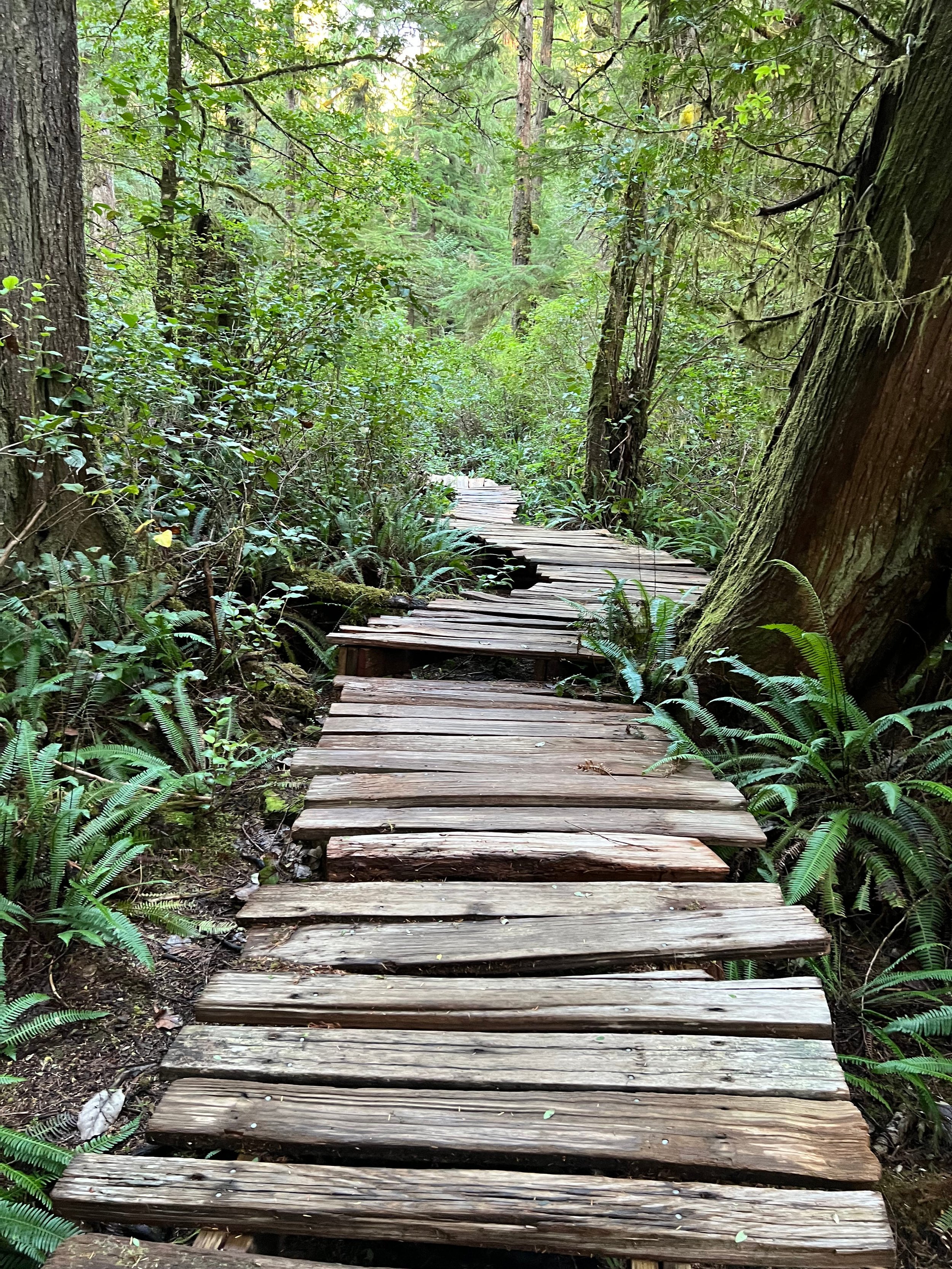
original photograph by B. Littleton, “Meares Island”
Continuing the series of my early writings from Literacy of Place (2004), here is today’s writings where I share the growing practice of Nature Guardians, and the deeper kinship of understanding who we are as humans, while in companionship with land, landscape, geography, place.
For many years conversations about environmental protection have centered on regulation, sustainability, conservation, carbon reduction, and compliance. These are important conversations, yet they often begin from the assumption that nature exists outside of us as an object to be managed, measured, protected, or exploited. What is emerging in some parts of the world suggests a very different question. Rather than asking how we can better manage nature, a growing number of organizations are beginning to ask how nature itself might be represented within the decision-making process.
This shift introduces us to the idea of the Nature Guardian.
What is a Nature Guardian?
A Nature Guardian is not simply an environmental consultant, nor is this person merely a sustainability officer whose role is to ensure compliance with regulations. A Nature Guardian serves as a representative of the Land itself, bringing the needs of ecosystems, watersheds, wildlife, forests, soils, and future generations into discussions that have historically been dominated by financial, legal, and operational concerns.
For many listeners, this may sound unusual, even radical. Yet when we pause for a moment, perhaps the more surprising reality is that such a role has not existed until now.
Modern corporations routinely grant legal standing to entities that cannot physically speak. A corporation itself is considered a legal person. Trusts, foundations, and investment vehicles are given representation and protection under the law. Boards appoint directors to represent shareholders, investors, employees, customers, and strategic interests. Yet the forests that provide the timber, the rivers that provide the water, the soil that produces the food, and the ecosystems that make all economic activity possible have traditionally had no voice at the table.
The Nature Guardian movement asks a simple but profound question:
If corporations are granted legal personhood, why should the Land remain voiceless? What is fascinating is that this idea is no longer theoretical.
Several pioneering organizations have begun formally changing their governance structures to include Nature in decision making. Perhaps the most widely cited example is the British company Faith in Nature, which became the first corporation in the world to appoint Nature as a director on its board. Through a legal proxy system, individuals with expertise in ecology, environmental law, and stewardship participate in board decisions specifically from the perspective of Nature’s interests.
What makes this development noteworthy is that Nature is not merely being consulted. Nature is being represented, and the distinction matters.
Consultation often occurs after major decisions have already been framed. Representation changes the conversation before decisions are made. It allows ecological concerns to enter the room at the same moment that financial projections, operational strategies, and shareholder expectations are being discussed.
Other organizations have followed similar paths. FutureEverything, an innovation and cultural organization in the United Kingdom, formally appointed Nature to its governance structure and has helped develop frameworks for other entities interested in doing the same. House of Hackney, a luxury interiors company, incorporated legal mechanisms designed to ensure that ecosystems have meaningful influence over corporate choices involving sourcing and production.
Alongside these governance innovations, many major corporations have begun creating executive-level positions focused specifically on Nature. Companies such as Chanel and Christian Dior have established leadership roles dedicated to climate, biodiversity, ecological impacts, and supply chain relationships with ecosystems. Microsoft has invested heavily in nature-based restoration strategies, recognizing that healthy landscapes are not simply environmental concerns but critical infrastructure for long-term resilience.
Although these positions differ from the Nature Director model, they reflect the same underlying realization. Business decisions do not occur apart from nature. Every product, every service, every supply chain, and every economic activity emerges from a relationship with the living world.
Canada offers another fascinating expression of this movement.
Rather than placing a single Nature Director on a corporate board, many Canadian resource projects have developed partnerships with Indigenous communities through Indigenous Guardians programs, Indigenous Advisory and Monitoring Committees, and land stewardship councils.
These initiatives emerge from a worldview that many Indigenous cultures have carried for thousands of years. Within this perspective, Land is not property. Land is relationship.
The capitalization of the word Land becomes important because it signals a shift in consciousness. Land is no longer viewed merely as terrain, acreage, or resource inventory. Land becomes a living presence that shapes identity, culture, memory, responsibility, and belonging.
Indigenous Guardians often serve as the eyes and ears of the Land. They monitor watersheds, wildlife populations, migration corridors, fisheries, forests, and culturally significant sites. They combine scientific monitoring with Traditional Ecological Knowledge developed through generations of direct relationship with place.
What makes these programs remarkable is that they bring knowledge gathered on the Land directly into executive and governmental decision making.
In the Trans Mountain Indigenous Advisory and Monitoring Committee, representatives from Indigenous nations participate in environmental oversight related to pipeline operations. Across Ontario, Indigenous Guardian initiatives work alongside forestry and mining operations to monitor watershed health, biodiversity, and long-term ecosystem resilience. Along the Pacific Coast, Coastal Guardian Watchmen programs monitor marine ecosystems and fisheries while collaborating with industries whose activities affect those waters.
These examples suggest a subtle but important transformation. Rather than treating environmental concerns as obstacles to development, they invite ecological knowledge into the center of planning itself.
When viewed through this lens, the Nature Guardian is not merely a new corporate role. The Nature Guardian becomes a symbol of a larger cultural evolution.
Pivoting from Hubris:
For centuries industrial societies have operated as though humans stand apart from nature. We have often imagined ourselves as managers of the natural world rather than participants within it. Yet every climate disruption, every drought, every wildfire, every disappearing species, and every declining watershed reminds us that separation was always an illusion.
The health of the Land and the health of human communities have never been separate realities.
Perhaps this is why the emergence of Nature Guardians feels so significant. It represents more than a policy innovation. It suggests the possibility of repairing a relationship.
Many of us have grown accustomed to asking what we can take from the Land. We ask how much timber can be harvested, how much water can be diverted, how much energy can be extracted, and how quickly development can proceed.
A Nature Guardian introduces a different question.
What does the Land need?
Such a question may initially appear simple, yet it changes the entire conversation.
What does the river need?
What does the forest need?
What does the watershed need?
What does the salmon need?
What does the future need from us?
The presence of a Nature Guardian ensures that these questions remain visible, even when economic pressures encourage us to forget them.
I find myself wondering whether the greatest contribution of this movement may not be legal or corporate at all. Its greatest contribution may be psychological.
A society reveals its values through what it chooses to represent. We appoint advocates for investors because investment matters. We appoint advocates for shareholders because ownership matters. We appoint advocates for customers because commerce matters.
What becomes possible when we appoint advocates for the Land because life itself matters? Perhaps the deeper invitation is not simply for corporations to adopt Nature Guardians. Perhaps the invitation is for each of us to become one. Not in a formal legal sense, but in the daily practice of remembering relationship.
What would change if every major decision included a brief pause to ask what serves the Land? What would change in our communities, our businesses, our schools, our politics, and our personal lives if we carried that question with us?
The emergence of Nature Guardians suggests that a new story may be taking shape. It is a story that does not reject business, innovation, or economic development. Rather, it asks whether these activities can unfold within a larger covenant of reciprocity.
The Land has always supported us. The question now appearing in boardrooms, Indigenous stewardship programs, and governance experiments around the world is whether we are finally willing to support the Land in return.
Questions We Either Ask or Ignore:
For much of modern Western culture, writers and thinkers have reminded us of the inexplicable kinship between humans, the land, and the cosmos, while simultaneously amplifying the limited, dominant culture focus of “What can I do with this land?” Yet the more important question often becomes, “What does this place ask of me?” That subtle shift changes everything. It moves us from possession to participation, from management to reciprocity, from entitlement to belonging.
One of the gifts is the reminder that the Land is not merely scenery. It is not a backdrop against which human life unfolds. It is an active participant in our becoming. The Land shapes our imagination, our health, our memories, our stories, our economies, and even our sense of self. When we lose relationship with place, we often lose relationship with aspects of ourselves.
Questions such as these, not as exercises to complete, but as companions to live with over time.
When was the last time I sat quietly enough to notice what is alive around me rather than what I am thinking about?
What species of birds, insects, trees, grasses, and animals share this place with me, and what does it say about my relationship to home if I cannot name my neighbors?
What was here before my house, before my neighborhood, before the roads and parking lots?
Whose ancestors walked this Land long before I arrived?
What stories does this place hold that I have never taken the time to hear?
How does this place shape my moods, my dreams, my creativity, and my sense of possibility?
What have I received from this Land that I rarely acknowledge?
If gratitude is a form of reciprocity, how am I expressing gratitude to the place that sustains me?
What does this watershed need from those who live within it?
What is the condition of the soil beneath my feet?
Where does my water come from before it reaches my faucet, and where does it go after it leaves my home?
What plants and animals are struggling here, and what might their struggles reveal about our collective choices?
What would change if I understood myself not as a resident of this place, but as a participant in its ongoing story?
If the Land could speak, what would it thank us for?
If the Land could speak, what would it ask us to stop doing?
If the Land could speak, what would it ask us to remember?
Our Authors, Thinkers, Guides:
For clarity, guidance, and further readings, these personal questions direct us to a body of work, starting with environmental writer Barry Lopez, who often invited readers to understand that landscapes are not empty spaces but carriers of intelligence and memory. These questions also echo Terry Tempest Williams’ writings/teachings that insist intimacy with place inevitably becomes a form of responsibility. Wendell Berry’s observation that affection precedes stewardship, that we care for what we have come to know and love echo the foundation of deep relationship with Land.
The teachings of author Leslie Marmon Silko continually presents an understanding that stories, people, animals, weather, and geography form a single living fabric rather than separate categories. Simon Ortiz contributes a vital understanding that language and place are inseparable. For him, words are not merely tools of communication but expressions of relationship, carrying within them the memory of the Land, the wisdom of ancestors, and the responsibilities of belonging. His work reminds us that when we speak of restoring our relationship with the Land, we are also speaking of restoring our relationship with story, identity, and voice itself.
And, finally, although not in any way comprehensive in reviewing the literature on ecological agency, is Bill Plotkin, founder of Animus Valley Institute and author of “Nature and the Human Soul,” where he explicitly poses the recurring invitation to ask how the larger Earth community participates in our own maturation and individuation. Jung observed that modern people often suffer not because they have too little information, but because they have lost contact with instinct, symbol, imagination, and the deeper layers of the psyche. Plotkin extends this observation by suggesting that we have simultaneously lost contact with the Earth. The psychological wound and the ecological wound mirror one another.
The question that continues to stay with me is one that gathers all of these voices into a single inquiry:
“What if the Land is not something we own, but someone we belong to?” This is not a new question, as our ancestors once held this question to be non-negotiable, as seen in our vast multicultural mythology of animism, and intricate cosmology of Nature gods, goddesses, and rituals.
This question is unsettling for many people now because it reverses centuries of assumptions, yet it may be one of the most important questions available to us at this moment in history.
If we belong to the Land rather than the Land belonging to us, then stewardship is no longer an environmental strategy. It becomes an expression of kinship. It becomes an act of remembering who we are within a much larger community of life.
And perhaps that is the deeper wisdom behind the emergence of Nature Guardians. They are not introducing a completely new idea. They are helping modern institutions remember an ancient one. The Land has never been a possession. It has always been a relationship.
From a Depth Psychological Perspective:
The emergence of Nature Guardians is not only a legal innovation or a governance experiment. It may also be a symptom of something deeper occurring within the collective psyche. When a culture begins creating formal roles to represent rivers, forests, watersheds, and ecosystems, it suggests that something long excluded is attempting to return.
From a depth psychological perspective, one might even say that the Land is returning from the cultural shadow.
For several centuries, many industrial societies have organized themselves around the assumption that nature is inert matter, raw material, property, or resource. Yet the human psyche has never fully accepted that reduction. Dreams remain populated with animals, forests, mountains, oceans, and weather. Mythologies across cultures speak of sacred groves, talking animals, living rivers, and mountains that possess wisdom. Children naturally relate to the more-than-human world as animate and alive before they are taught otherwise.
What if the rise of Nature Guardians is one expression of the psyche attempting to restore a relationship that was never meant to be severed?
That possibility opens another series of questions that move beyond policy and into personal inquiry:
What part of myself becomes more alive when I spend time in relationship with a particular place?
What have I forgotten because I no longer spend time listening to the natural world?
Which landscape has shaped me most deeply, and what qualities of that place now live within me?
Where do I experience wonder?
Where do I experience belonging?
What places feel like home to my body, even when they are unfamiliar to my mind?
What landscape appears most often in my dreams, memories, fantasies, artwork, or imagination?
What might that landscape be attempting to teach me?
These are questions I could imagine Wendell Berry asking while walking a Kentucky hillside, Terry Tempest Williams contemplating in the desert, Barry Lopez listening to the stories held within an Arctic landscape, Simon Ortiz remembering the inseparability of language and place, Leslie Marmon Silko tracing the living relationship between story and geography, or Bill Plotkin guiding someone toward a deeper ecological identity.
Each of them, in their own way, reminds us that the healing of the Earth and the healing of the human psyche may not be separate projects. Perhaps the most hopeful aspect of the Nature Guardian movement is that it invites us to imagine institutions doing what individuals have been trying to learn all along: becoming capable of relationship, reciprocity, humility, and listening.
In this sense, the question is no longer whether corporations should appoint Nature Guardians. The deeper question may be whether all of us are willing to become guardians of the relationships that make life possible. Perhaps the Land, patient as ever, has been waiting for us to validate the quest to see, hear, and accept how an archetypal presence in the history of humanity, keeps us alive.
One thing I have learned from integrating the threads of Berry, Lopez, Williams, Ortiz, Silko, and Plotkin, Jung is that conversations about the Land often become conversations about much more than the Land. People may initially think they are discussing ecology, conservation, or corporate governance, only to discover they are really exploring belonging, identity, memory, ancestry, responsibility, and what it means to live well in a place.
That is one reason I think the Nature Guardian concept has such power. It is concrete enough to be understood through policy and organizational structures, yet symbolic enough to open deeper questions about our collective relationship with the living world at a time where national policies threaten our surrounding communities and historic sanctuaries of federal lands.
written by Bren Littleton, June 13th, 2026
original photograph by B. Littleton, “Meares Island”
Tin Flea Press, c. 2026