
How History Informs Our Somatic Grief
The same silence that swallowed Irish history is already swallowing the histories of our weakest populations.
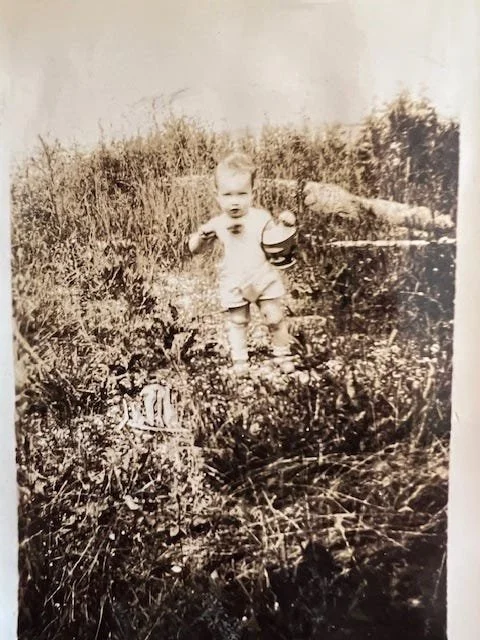
Original photo: Nan, in Cork, Ireland.
I write from a convergence of history, ancestry, and lived somatic recognition.
I am a depth psychologist, a Jungian coach, and a student of ancestral medicine. I am also a descendant of Irish famine-era emigration. My grandmother was born in Cork and immigrated as a child to Canada. That lineage moves through my father, and into me. I do not tell her story here. I listen instead for what moved through her, through him, and now lives in my body. I write with the understanding that history is not only a record of events, but an inheritance carried in nervous systems, behaviors, and unspoken loyalties.
I have come to know history as something that lives in the body long after it disappears from textbooks. As something the ego learns to turn away from in order to survive, while the soul quietly remembers. When grief has no witness, when terror has no ritual completion, when loss is normalized rather than named, the body adapts. Over generations, those adaptations are passed on as vigilance, silence, endurance, and a complicated relationship with authority and belonging.
This essay is written as witness rather than argument. It arises from the belief that tending ancestral wounds is not about remaining in the past, but about preventing their unconscious repetition. What we do not remember well, we reenact. What we refuse to feel, we project.
I begin before invasion, before occupation, before the long rehearsal of forgetting.
Before 1169, Ireland was not empty, nor chaotic, nor waiting to be civilized. It was a living culture with its own intelligence. Law was relational. Land was held in trust rather than owned outright. Kinship organized social life. Poetry carried history. Women held lineage. The body and the land were not separate ideas. Harm required repair. Power carried responsibility. Life moved according to season, story, and obligation to one another. That world was not idealized, but it was coherent. It was whole.
The interruption begins in 1169, when Anglo-Norman mercenaries landed in Ireland at the invitation of an Irish king. What began as a localized military alliance quickly became a foothold for conquest. In 1171, Henry II arrived and declared himself Lord of Ireland, marking the formal beginning of English occupation. At first, English control was limited to the area around Dublin, later known as the Pale. Beyond it, Irish law, language, and culture persisted.
But occupation is patient. Over the next four centuries, English authority expanded through land seizures, shifting alliances, military campaigns, and the systematic dismantling of Irish sovereignty.
By the sixteenth century, domination hardened into state policy. Under Henry VIII, who declared himself King of Ireland in 1541, English rule shifted decisively from overlordship to total control. Irish legal systems were outlawed. Clan leaders were executed or dispossessed. Land was confiscated at scale. Resistance was reframed as treason.
Under Elizabeth I, from 1558 to 1603, scorched-earth warfare became explicit policy. Crops were burned. Livestock seized. Villages destroyed. Starvation was deliberately used as a tool of pacification. Hunger became governance. This violence was not episodic or chaotic. It was administrative.
In the early seventeenth century, the Plantation system intensified dispossession, especially in Ulster, forcibly removing Irish Catholic landholders and replacing them with English and Scottish Protestant settlers. Land became the primary instrument of domination. To lose land was to lose food, history, and future in one stroke.
The devastation escalated further during 1649–1653 under Oliver Cromwell. Massacres at Drogheda and Wexford, widespread land confiscation, forced displacement, and deportation followed. By the 1650s, Irish Catholics had lost the vast majority of their land. The phrase “To Hell or to Connacht” captured not rhetoric, but geography.
From the late seventeenth century through the eighteenth, the Penal Laws formalized domination. Irish Catholic life was made deliberately smaller, poorer, and quieter. Land ownership, education, political participation, and professional advancement were systematically denied. Priests were hunted. Education went underground into hedge schools. Inheritance was fractured by law. Poverty was engineered.
Women bore the consequences first and longest. When crops were burned, mothers faced children with empty bowls. When rent was due, women stretched meals and absorbed shame that did not belong to them. When men were imprisoned, executed, or transported, women became the infrastructure of survival. Culture retreated into kitchens, prayers, songs, and bodies.
The Great Famine of 1845–1852 did not create suffering; it revealed a system already designed to let people die. Over one million died. At least another million emigrated. Food continued to be exported. Rent continued to be collected. Evictions continued. Hunger was moralized. Starvation was framed as failure.
Resistance, however, did not begin with rifles or proclamations. It began much earlier, and much closer to the body. It began with people continuing to speak Irish when it was forbidden. With mothers teaching children songs whose meanings were disguised as lullabies. With hedge schools hidden in fields. With women carrying news in baskets, sewn into hems, disguised as ordinary errands. It began with a collective refusal to let culture die quietly.
When I trace this history through the lens of the nervous system, I notice that Irish resistance often took forms that preserved connection rather than dominance. It was adaptive, covert, and relational. These were not romantic traits. They were survival strategies shaped by centuries of punitive power.
By the late eighteenth century, resistance became more overt. The 1798 Rising erupted from accumulated grievance, hunger, land theft, and humiliation. It was brutally suppressed. The pattern repeated. Rebellion rose. The state responded with overwhelming force. Each time, the lesson was etched deeper into the collective body: hope is dangerous, but silence is deadly. This is how trauma teaches contradiction.
Women were never on the margins of this struggle. They were its infrastructure. During the nineteenth and early twentieth centuries, women organized boycotts during the Land War, hid fugitives, nursed the wounded, carried arms, ran safe houses, and sustained families under constant threat. Mothers lived with the daily terror of eviction, imprisonment, or execution arriving at the door. Hypervigilance became a form of love.
Through my study of Ancestral Medicine, I have come to understand that trauma does not require direct memory to persist. It requires interruption without repair. Unresolved grief, terror, and powerlessness lodge in the nervous system when there is no safe witness, no ritual completion. Over time, these states become inherited tendencies: vigilance without threat, shame without cause, loyalty to suffering long after danger has passed.
Ireland is a case study in this. Centuries of domination trained bodies to scan for danger, to read authority as volatile, to associate land not with safety but with loss. Even joy had to be moderated. Prosperity invited punishment. Visibility carried risk. This is not metaphor. It is physiology.
Irish resistance was not only an effort to remove an occupying power. It was an effort to restore relationship: to land, to language, to dignity, to self-determination. Political independence in 1922 did not automatically resolve ancestral injury. The nervous system does not reset with treaties. Trauma requires tending.
I feel this now when contemporary abuses of power unfold. When governments speak of people as problems to be managed, when suffering is bureaucratized, my body recognizes the posture. My breath changes. My shoulders tighten. It is not paranoia. It is memory without images.
From 1169 to 1922, roughly 750 years, England and later Britain occupied, administered, punished, and extracted from Ireland. Seven and a half centuries is long enough that forgetting becomes intentional.
The same part of us that forgets those 750 years is the part of us now willing to forget who is being harmed today. The same amnesia that minimizes white-on-white ethnic cleansing allows contemporary suffering to be dismissed as exaggerated or deserved. The same silence that swallowed Irish history is already swallowing the histories of our weakest populations.
What lies in me is not only grief, but also the recognition of how domination and power believe they have the right to colonize the soul. And yet, it is the soul that carries true memory. The ego, trained for survival, learns to look away from the unbearable in order to survive. But the soul does not forget.
It is the soul that can return to sovereignty, regardless of who the current oppressor may be. It is the soul that carries the wound-aware truth.
written by Bren Littleton
Original photo: Nan, in Cork, Ireland.
Tin Flea Press c. 2026