
ADHD: An Interruption of Movement
Hosting ADHD Through the Personal Literacy of Stress, Grief, Creativity, and the Emergence of a New Way to Live.
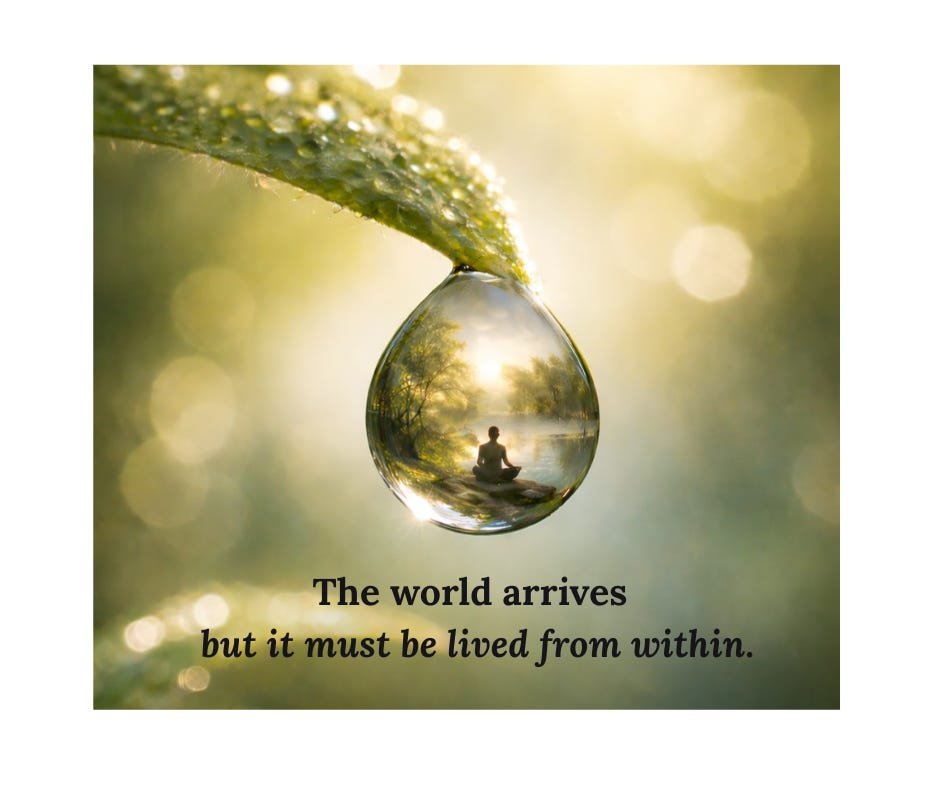
Image created in Canva
“The soul begins to speak when we can no longer carry on as we have.”
— Marion Woodman
Something entered my life, unnamed at first, though I felt its presence with increasing clarity. My creativity remained strong, active, and seemingly without end, yet I found myself falling out of love with being creative. This condition did not arrive as a crisis, but instead revealed itself as a subtle interruption, a hesitation where there had once been decisive movement. I could still think, still imagine, still perceive the intricate shape of what wanted to be created, yet when I reached toward it, something in me did not move. This was not a decision, not a refusal, and not a resistance I could reason with. The energy was present, I could feel its direction and its quiet insistence, yet something in me did not translate that energy into action. The body did not organize around it. It did not initiate. I remained still, as though the signal had arrived but could not be carried forward.
I began to live within a strange doubleness. One part of me remained fully aware, observing, understanding, tracking ideas as they formed and gathered. Another part, quieter yet more powerful, refused to act. This was not resistance, it was presence. I was hosting something uninvited, something indifferent to preference or will. It altered the terms of engagement, not only with my work, but with my sense of self. The creativity did not disappear. The relationship to it changed.
What revealed itself over time was not a failure of discipline or a diminishment of intelligence, but a disruption in the continuity between intention and action. Awareness did not diminish; it sharpened. I could see the gap with precision and feel it as a measurable distance I could not reliably cross.
I did not arrive at ADHD easily. The term felt too narrow, too quick, for an experience that was layered, embodied, and historically shaped. I resisted it at first. Yet as the pattern persisted, curiosity replaced dismissal.
In time, I began to consider ADHD not as a limitation, but as a lens. It marked the beginning of understanding this experience as a lived condition, one in which thought, energy, and movement no longer aligned in a predictable way.
“When a woman tells the truth she is creating the possibility for more truth around her.”
— Adrienne Rich
In the work of Gabor Maté, attention is understood as something shaped by experience rather than fixed at birth. ADHD, in this view, reflects an adaptation to stress, to environments in which sustained presence carried a cost. This perspective did not excuse the experience, but it gave it context. It shifted the inquiry from what is wrong to what has occurred.
Tracing my own experience more honestly revealed that this disruption did not arise in isolation. It followed a period of deep grief. Not a single event, but an extended encounter with loss that moved through the body in waves, dissolving structures which had once held. This grief reopened earlier imprints and earlier adaptations, ways the system had learned to cope with what could not be metabolized at the time. In this reopening, something familiar returned, though I did not recognize it immediately.
The mind remained active. The imagination remained intact, yet the bridge between intention and action became unreliable. The ideas were still there. The creativity had not diminished, yet the capacity to enter it, to inhabit it, to move with it, no longer followed automatically. There was no flow. This is the aspect of ADHD that is rarely described with precision. The difficulty is not knowing what to do. It is not a lack of care. It is not even the absence of energy in a general sense. The difficulty lies in activation.
In earlier times, this experience would have been named differently. It might have been called melancholia, a quiet withdrawal of vitality from the world. It might have been understood as burnout, the exhaustion that follows prolonged overextension. It might have been framed as a midlife crisis, a necessary dismantling of identity in the face of accumulated strain. It might have been softened into the language of finding oneself, or misread as the cost of being highly driven, a Type A personality reaching its threshold. In more recent years, it has been folded into the language of multitasking and attention fatigue, as though the nervous system were simply overburdened by modern demands.
Each of these frameworks holds a fragment of truth. Each recognizes a loss of continuity, a disruption in energy, a change in relationship to one’s life. Yet none fully account for the specific experience of awareness remaining intact while the capacity to initiate becomes unreliable.
The current language names this pattern as ADHD. I use that term with care. Not as a fixed identity, and not as a reduction of complexity, but as a way of locating this experience within a shared and recognizable field. What I am describing has existed long before the label. It appears in the literature of melancholia, in accounts of creative paralysis, in spiritual texts that speak of the dark night, and in psychological descriptions of dissociation and withdrawal.
What distinguishes this experience, as I have come to understand it, is not simply a loss of energy, but a disruption in the translation of energy into action. The system does not fail, it reorganizes. It withdraws from conditions it can no longer sustain, even while awareness continues to perceive what is possible.
This is where the language of ADHD, once resisted, began to hold. Not as a reduction, but as a point of entry. It offered a way to recognize a pattern I had already been living, one that earlier frameworks had only partially named.
In the language of Daniel Amen, the brain requires consistent engagement of prefrontal systems to initiate, organize, and sustain action. When those systems are underactive or inconsistent, mobilization becomes unreliable. This clarified something essential: I was not resisting my life. I was inhabiting a system that could not consistently generate the energy required to begin.
The body made this even clearer. In the work of Bessel van der Kolk, unresolved experience is carried somatically and expressed through patterns of regulation and protection. Sitting inside the moments of non-movement, I could feel a subtle tightening before action, a hesitation that preceded thought. A question was being asked in sensation rather than language. Is this safe? Is this too much? Will this expose me beyond what I can hold? Can I do this?
The answer arrived as state. When uncertainty dominated, my movement stopped. From the outside, this appears as inactivity. From the inside, it reflects an intelligent system assessing risk and choosing conservation over exposure. What I once named as failure revealed itself as adaptation.
“Caring for myself is not self-indulgence, it is self-preservation, and that is an act of political warfare.”
— Audre Lorde
For decades, my attention moved outward. I listened for others, guided them, helped them articulate what they could not yet name. I knew how to sit with confusion and remain steady. I knew how to help rebuild meaning from fracture. What I had not yet learned was how to apply that same presence inward when the fracture was no longer observed but inhabited.
The body had been signaling for years. The appestat quieted, hunger and satiation lost clarity. Sleep became optional rather than restorative. Brain fog appeared, not as confusion, but as a dimming of available energy. These were not isolated symptoms. They formed a coherent pattern. The body was reorganizing under the weight of what had not yet been integrated.
“Rarely, if ever, are any of us healed in isolation. Healing is an act of communion.”
— bell hooks
This pattern extended beyond my own experience. Clients described a similar arc. Energy for meaningful work declined, while short bursts of focus and intensity gave way to prolonged stretches of lethargy, confusion, and brain fog. In those quieter periods, many turned toward regulating behaviors that offered temporary relief, including shopping, over-exercising, eating patterns, social media, gaming, and more recently, continuous engagement with AI. There was even a shared recognition that where a therapist once held their inner world, a digital presence now reflected it back, tracking not only their thoughts, but the recurring patterns within these gaps.
These cycles were not failures of character but attempts at regulation within a chronic rhythm of stimulation followed by depletion. The system searched for balance using whatever behavior was available, often attaching with an intensity that resembled addiction. Beneath this pattern was a deeper impulse toward connection, rooted in survival, emerging most strongly when uncertainty disrupted the system’s sense of continuity.
These patterns do not remain abstract. Under sustained stress, the system develops its own forms of compensation, often subtle, often misread, yet organized around the same need to regulate and preserve continuity. This, too, falls within the broader pattern now described as ADHD, not as a category, but as a way of recognizing how the system adapts when continuity breaks down.
I had already encountered a version of this pattern. After completing my dissertation, a work of deep personal and intellectual significance, I lost the ability to read. Not briefly, but for over a year. Reading, once central to my life, was no longer accessible. No matter what I picked up to read, after a quick glance, I did not have the capacity to stay with the message. I explained it as completion. I told myself I did not have the bandwidth to understand written language.
Years later, during a conversation about academic burnout, a colleague shared the same experience without prompting. She, too, could not read after completing her dissertation. The moment carried an unexpected sense of validation. What I had experienced in isolation revealed itself as shared.
Looking back, the context becomes clear. The dissertation was written under sustained pressure. Divorce, foreclosure, professional demands, and health concerns formed the backdrop. What appeared as completion contained unprocessed strain. The system had reached its limit.
Completion in form does not guarantee completion in experience. When the body carries work under strain, it may withdraw once the demand lifts. This is not failure, but instead is protection.
This reframes the question entirely. These moments of depletion and withdrawal begin to look less like breakdown and more like early signals. A system under sustained stress reorganizing in real time.
Grief activated deeper layers of abandonment within me. Not dramatically, but through quiet withdrawal. Energy receded and initiation faltered. What once felt natural required negotiation. Even creativity, once a place of vitality, became something I could see but not consistently enter. What might once have been called melancholia, or later named burnout, or even interpreted as a midlife unraveling, revealed itself here as something more precise. The system was not simply depleted. It was reorganizing. These were not random disruptions, but were meaningful responses.
This is what I call Personal Literacy. The ways we learn to read environments and adjust ourselves to survive them. We become fluent in expectation, pressure, and relational dynamics. These adaptations allow function and even excellence, but they are built on survival rather than full expression.
When grief enters, or when life shifts enough to dissolve these structures, the system reorganizes. Old patterns re-emerge, not as regression, but as unfinished responses returning to the surface. ADHD, in this light, becomes visible not as identity, but as condition. The inability to initiate reflects the intersection of safety, energy, and history.
What I had once resisted as too narrow revealed itself here as precise. Not because it explained everything, but because it pointed directly to the place where translation breaks down, where awareness remains intact but movement does not follow.
Shame often fills this space. The gap between capacity and action becomes visible. The weight of unrealized movement accumulates. Yet when the experience is met with attention rather than judgment, something else emerges alongside it: Understanding.
The question shifts from why do I not follow through, to what conditions allow movement to occur?
Movement does not arise from pressure in this system, it arises from alignment. For alignment to be present the body must register safety. The task must be small enough to enter. The engagement must carry meaning or curiosity. The internal voice must allow the process to unfold without attack.
Under these conditions, entry becomes possible. Not into the full vision, but into a point of contact. A sentence. A note. A small act of completion. Each completed movement rebuilds trust. Not abstract confidence, but embodied reliability.
What emerges is not discipline in its conventional sense, but translation. The capacity to translate vision into action without overwhelming the system that must sustain it.
ADHD, viewed this way, reflects the interaction between attention, safety, energy, and lived history. For those who are highly functional and deeply creative, this pattern can remain hidden for years beneath competence and performance, often misnamed as drive, ambition, or the cost of being a certain kind of mind. It is only when the continuity breaks, when what once carried us forward no longer does, that the underlying condition becomes visible.
It is often only after the interruption, after resistance gives way to curiosity and curiosity to recognition, that the condition can be named without reduction. By then, the language no longer defines the experience. It clarifies it.
Something entered my life, unnamed at first, and I lived for a time as though it were an interruption, a hesitation where there had once been decisive movement. I understand now it was not an interruption, but an invitation. The movement did not disappear. It changed its terms. It asked for a different kind of listening, a different kind of beginning. The distance I once could not cross has become a place I can stand within, attentive, responsive, and guided now by a curiosity that no longer seeks to control the movement, but to understand it, especially in those moments when continuity begins to break down. This is not a return to the life I once carried forward. It is the shaping of a new life I am now able to inhabit, where awareness and action meet in the same ground.
“One does not become enlightened by imagining figures of light, but by making the darkness conscious.”
— Carl Jung
written by Bren Littleton
April 7th, 2026
Image created in Canva
Tin Flea Press c. 2026